pyfod package
Submodules
pyfod.fod module
This module provides support for three common definitions of fractional
derivative in the limiting case of  . The
definitions available include:
. The
definitions available include:
Riemann-Liouville -
riemannliouville()Caputo -
caputo()Grünwald-Letnikov -
grunwaldletnikov()
For more details regarding this definitions of fractional derivatives please see [Pod98].
Note
In each method you are required to provide a function handle. Depending on the method being used, you may need to define your function using sympy to allow for extended numerical precision.
-
pyfod.fod.caputo(f, lower, upper, dt=0.0001, alpha=0.0, df=None, quadrature='GLegRS', **kwargs)[source]¶ Caputo fractional derivative calculator for
.The general definition for Caputo fractional derivative is
![D_{C}^\alpha[f(t)] = \frac{1}{\Gamma(n-\alpha)}
\int_0^t\frac{f(s)^{(n)}}{(t-s)^{\alpha+1-n}}ds,](_images/math/8dcd26047a68f8d0d4f78d9eb1eea0e976adc68c.png)
where
 . In the limiting case where
 this further simplifies to
![D_{C}^\alpha[f(t)] = \frac{1}{\Gamma(1-\alpha)}
\int_0^t\frac{f(s)^{(1)}}{(t-s)^{\alpha}}ds.](_images/math/eebfc4a608f463c84c0d142ef44e8bd2c100a732.png)
To evaluate this we simply need to define a finite-difference scheme for approximating
 .
.- Args:
- Kwargs: name (type) - default
- Returns:
dict fd: Fractional derivative.
i1: Value of integral.
q1: Quadrature object.
 .
.-
pyfod.fod.grunwaldletnikov(f, lower, upper, n=100, dt=None, alpha=0.0)[source]¶ Grünwald-Letnikov fractional derivative calculator.
We have implemented the reverse Grünwald-Letnikov definition.
![D_G^\alpha [f(t)]=\lim_{h\rightarrow 0}\frac{1}{h^\alpha}
\sum_{0\leq m< \infty}(-1)^m\binom{\alpha}{m}f(t-mh).](_images/math/18df03616716cdd8ec35269b9323cbdcf272f777.png)
Note
The package as a whole was built for problems where
; however, this definition for
Grünwald-Letnikov does not necessarily have the same constraints.
It has not been tested for values of  ,
but in principle it will work.
,
but in principle it will work.- Args:
- Kwargs: name (type) - default
- Returns:
dict fd: Fractional derivative.
-
pyfod.fod.riemannliouville(f, lower, upper, dt=0.0001, alpha=0.0, quadrature='GLegRS', **kwargs)[source]¶ Riemann-Liouville fractional derivative calculator for
.The general definition for Riemann-Liouville fractional derivative is
![D_{RL}^\alpha[f(t)] = \frac{1}{\Gamma(n-\alpha)}
\frac{d^n}{dt^n}\int_0^t\frac{f(s)}{(t-s)^{\alpha+1-n}}ds,](_images/math/e94b6aeefaeade26c40bba379cd9f6248ff87d08.png)
where
. In the limiting case where
this further simplifies to![D_{RL}^\alpha[f(t)] = \frac{1}{\Gamma(1-\alpha)}
\frac{d}{dt}\int_0^t\frac{f(s)}{(t-s)^{\alpha}}ds.](_images/math/bc51475e26b531f77f4e4ce855622392ddd26855.png)
By defining
![F[t] = \int_{t_0}^t(t-s)^{-\alpha}f(s)ds,](_images/math/6a5552e185884101c459c85aae0a0dbbf78ea2e3.png)
we can numerically approximate this definition of fractional derivative as
![D_{RL}^\alpha[f(t)] = \chi\frac{d}{dt}F[t] \approx
\chi\frac{F(t_{j+1}) - F(t_{j})}{t_{j+1}-t_{j}},](_images/math/d18341fe5736770e8211f713fc1bd613f3f0030b.png)
where
 . For more details regarding
this approach please see [AGomezA17]
and [MPOS18].
. For more details regarding
this approach please see [AGomezA17]
and [MPOS18].- Args:
- Kwargs: name (type) - default
- Returns:
dict fd: Fractional derivative
i1: Value of integral
 .
.i2: Value of integral
 .
.q1: Quadrature object for
.q2: Quadrature object for
 .
.
pyfod.quadrature module
This module contains a variety of classes for performing quadrature. While this
module was developed to support the fractional derivative calculators in
fod, the quadrature methods themselves are still applicable to a
wide variety of integration problems.
The quadrature methods are defined to approximate integrals of the form
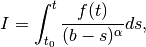
where  is typically equal to
  . The user is only required
to provide the function
. The user is only required
to provide the function  and the limits of integration.
We observe that by setting
and the limits of integration.
We observe that by setting  , this integral is transformed to
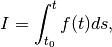
which is applicable to many problems.
-
class
pyfod.quadrature.GaussLaguerre(deg=5, lower=0.0, upper=1.0, alpha=0.0, f=None, extend_precision=True, n_digits=30, singularity=None)[source]¶ Bases:
objectGauss-Laguerre quadrature.
- Kwargs: name (type) - default
deg (
int) - 5: Degree of laguerre polynomials.lower (
float) - 0.0: Lower limit of integration.upper (
float) - 1.0: Upper limit of integration.alpha (
float) - 0.0: Exponent of singular kernel.f (def) - None: Function handle.
extend_precision (
bool) - True: Flag to use sympy extended precision.n_digits (
int) - 30: Number of digits in extended precision.singularity (
float) - None: Location of singularity.
 . To
facilitate usage of the quadrature object, you can update the
weights with a new
. To
facilitate usage of the quadrature object, you can update the
weights with a new -
class
pyfod.quadrature.GaussLegendre(ndom=5, deg=5, lower=0.0, upper=1.0, alpha=0.0, f=None, singularity=None)[source]¶ Bases:
objectGauss-Legendre quadrature.
- Kwargs: name (type) - default
ndom (
int) - 5: Number of quadrature intervals.deg (
int) - 5: Degree of legendre polynomials.lower (
float) - 0.0: Lower limit of integration.upper (
float) - 1.0: Upper limit of integration.alpha (
float) - 0.0: Exponent of singular kernel.f (def) - None: Function handle.
singularity (
float) - None: Location of singularity.
-
class
pyfod.quadrature.GaussLegendreGaussLaguerre(ndom=5, gleg_deg=4, glag_deg=20, percent=0.9, ts=None, lower=0.0, upper=1.0, alpha=0.0, f=None, extend_precision=True, n_digits=30)[source]¶ Bases:
objectGauss-Legendre, Gauss-Laguerre quadrature.
- Kwargs: name (type) - default
ndom (
int) - 5: Number of Gauss-Legendre quadrature intervals.gleg_deg (
int) - 4: Degree of legendre polynomials.glag_deg (
int) - 20: Degree of laguerre polynomials.percent (
float) - 0.9: Percentage of interval in which to use Gauss-Legendre method.ts (
float) - None: User-defined time to switch from Gauss-Legendre to Riemann-Sum quadrature.lower (
float) - 0.0: Lower limit of integration.upper (
float) - 1.0: Upper limit of integration.alpha (
float) - 0.0: Exponent of singular kernel.f (def) - None: Function handle.
extend_precision (
bool) - True: Flag to use sympy extended precision.n_digits (
int) - 30: Number of digits in extended precision.
-
class
pyfod.quadrature.GaussLegendreRiemannSum(ndom=5, deg=4, nrs=20, percent=0.9, ts=None, lower=0.0, upper=1.0, alpha=0.0, f=None)[source]¶ Bases:
objectGauss-Legendre, Riemann-Sum quadrature.
- Kwargs: name (type) - default
ndom (
int) - 5: Number of Gauss-Legendre quadrature intervals.deg (
int) - 4: Degree of legendre polynomials.nrs (
int) - 20: Number of Riemann-Sum quadrature intervals.percent (
float) - 0.9: Percentage of interval in which to use Gauss-Legendre method.ts (
float) - None: User-defined time to switch from Gauss-Legendre to Riemann-Sum quadrature.lower (
float) - 0.0: Lower limit of integration.upper (
float) - 1.0: Upper limit of integration.alpha (
float) - 0.0: Exponent of singular kernel.f (def) - None: Function handle.
-
class
pyfod.quadrature.RiemannSum(n=5, lower=0.0, upper=1.0, alpha=0.0, f=None, singularity=None)[source]¶ Bases:
objectRiemann-Sum quadrature.
- Kwargs: name (type) - default
pyfod.utilities module
-
pyfod.utilities.check_alpha(alpha)[source]¶ Check value of fractional order.
The package is designed to work on problems where the fractional order has a value in in the range [0, 1).
- Args:
alpha (
float): Order of fractional derivative.
- Raises:
System exit for ZeroDivisionError.
-
pyfod.utilities.check_input(value, varname=None)[source]¶ Check value is defined.
This routine checks that value is defined.
- Args:
value (user defined): Value being tested
- Kwargs: name (type) - default
varname (
str) - None: Name of variable/value being tested. This provides a more descriptive output for debugging.
If not properly defined
- Raises:
System exist for no value defined.
-
pyfod.utilities.check_node_type(n)[source]¶ Check that number of nodes is an integer.
- Args:
n (user defined): Number of nodes.
- Returns:
int(n)
-
pyfod.utilities.check_range(lower, upper, value)[source]¶ Check that value falls within [lower, upper] range.
- Args:
If value in range,
- Returns:
value (
float)
else
- Raises:
System exit for value out of domain.
-
pyfod.utilities.check_singularity(singularity, upper)[source]¶ Check singularity was defined.
This routine checks if user provided a singularity location. Default behavior is to use the upper limit of integration as the singularity location.
-
pyfod.utilities.check_value(value, default_value, varname=None)[source]¶ Check value with respect to default.
This routine checks that value is defined by either a user-defined value or default value. If still None, then something went wrong and this raises an error message.
- Args:
value (user defined): Value being tested
default_value (method defined): Default value
- Kwargs: name (type) - default
varname (
str) - None: Name of variable/value being tested. This provides a more descriptive output for debugging.
If properly defined
- Returns:
value
else
- Raises:
System exist for no value defined.